Honorable mentions (These are shows that I watched, appreciated, but honestly still haven’t finished and, frankly, find kind of dreary):
Game of Thrones
Westworld
The Man in the High Castle
American Horror Story
The 100
Orphan Black
Mr. Robot
The Handmaid’s Tale

25. The Mandalorian
Okay, it’s too new to fairly assess, but it earns a spot because it succeeds so well as a proof of concept: the first live action Star Wars story not to feature a single character from the original films (even the Ewok movies had Wicket). Given that “The Skywalker Saga” seems to be ending disappointingly, this show demonstrates that the franchise can focus on what it was always best at, world building, and doesn’t have to be beholden to a particular narrative. Also, it looks amazingly cinematic--gotta love that Disney money.24. The Netflix Marvel shows
This is another one that earns a spot based on its strengths as a proof of concept. The idea of an interconnected TV universe running parallel to the cinematic universe was a lot cooler in theory than in execution. These shows ended up being a slog. Still, Jessica Jones, Luke Cage, and Matt Murdock are interesting characters who are well-realized; had each series been a single eight-episode season rather than multiple 13-episode seasons, they might have been great.23. Runaways
This is, in many ways, the show I wish the Netflix Marvel shows had been. It still sometimes took itself too seriously, but it was generally breezier and more willing to embrace its comic book roots.22. The CW DC shows
Speaking of embracing comic book roots…. I honestly couldn’t keep up with the “Arrowverse” shows, but to have built out a universe as expansive as this one is an amazing feat. By my count, it features five official series and four contemporaenously related series, and it’s roped in characters and material from five older series. This is not counting several spinoff web series and references to various movies. It might be cheesy and have a much smaller budget, but it far exceeds Marvel in terms of storytelling scope.21. The Amazing World of Gumball
I appreciate this show’s manic energy, and its artful blending of radically different animation styles.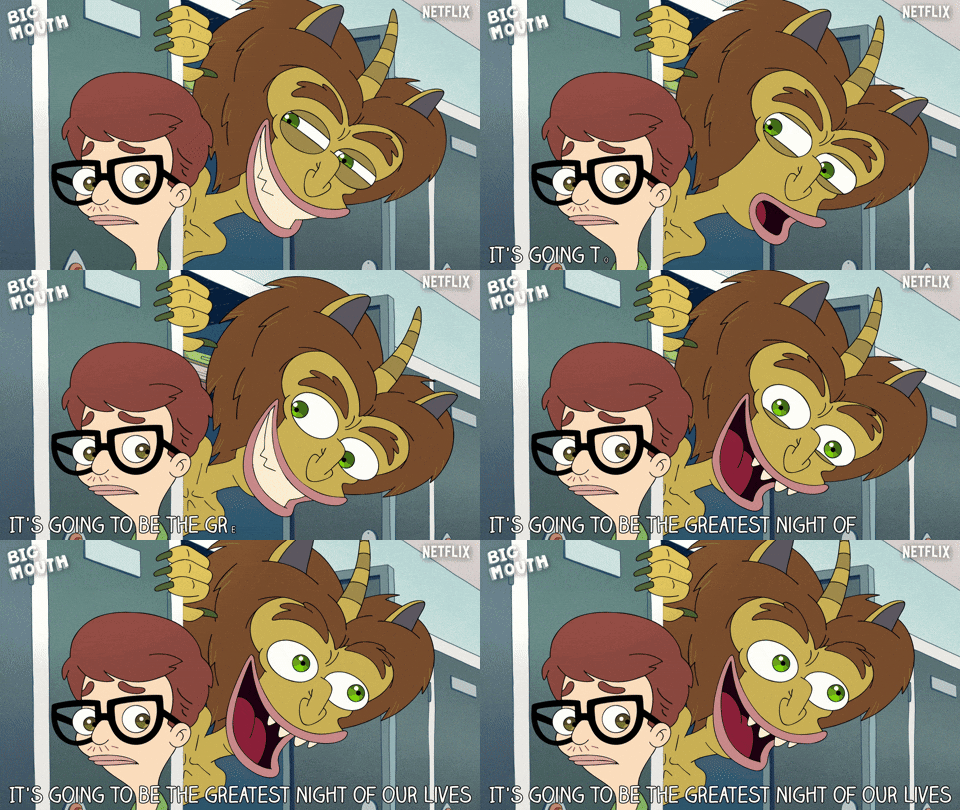
20. Big Mouth
This show could’ve been another Family Guy, and it’s really impressive that it has avoided going that route for three seasons now. It’s far from perfect, but it’s a lot more thoughtful than you’d expect from a show with this many dick jokes.19. Person of Interest
Okay hear me out: yes it’s a CBS procedural that superficially looks like it could be another NCIS spinoff, and yes its take on cops and the surveillance state is ultimately really disturbingly right wing. But it’s also a really in-depth consideration of the ontology of artificial intelligence, how an artificial intelligence would think differently, and how one might communicate with an artificial intelligence. The moments when it goes full William Gibson are pretty great. And it has Michael Emerson, Amy Acker, and a pre-Empire Taraji P. Henson.18. Russian Doll
I don’t know what to say about this show except Natasha Lyonne is awesome.17. Black Mirror
I’ve seen people call this show technophobic or preachy, but I think that misses the mark; it uses technology as a touchstone to explore different kinds of relationships and the functioning of civic institutions. It’s not The Twilight Zone, but it hits the spot.16. Rick and Morty
Its insufferable fandom aside, it’s just a really witty and well made show.15. Stranger Things
I’m annoyed that it became more zeitgeisty than the other Netflix shows that are higher on the list, but it’s still a damn fun show and a really impressive pastiche.14. The Americans
Okay, it’s a stretch to include this on a list of fantastic shows, but it’s a sort-of alternate history spy show, and that’s close enough, and it’s clearly one of the best shows of the decade.
13. The Good Place
Like the Americans, this is another one that doesn’t need me to sell it; it’s just an obviously great show.12. 3%
Brazillian dystopian show on Netflix. If you haven’t checked it out, do so ASAP. It’s a superb illustration of how the perpetuation of inequality depends on widespread mythologizing of the idea of meritocracy.11. Bojack Horseman
A good old fashioned Hollywood satire that is also a uniquely modern exploration of the entertainment industry in the Me Too era. It also has some of the best word play in TV history.10. Agents of SHIELD/Agent Carter
I made a pointed decision to put this in the top ten, because not only do I maintain that these are the best TV shows based on superhero comics to have come out in the past decade, I also argue that they’re the shows that demonstrate that there’s still some value in, for lack of a better term, 90’s-style TV. AoS doesn’t have movie stars in its regular cast, it has a limited budget, it’s largely episodic, and its act structure rigidly adheres to the requirements of commercial breaks. It’s comfortingly familiar and old fashioned in so many ways, but it’s still damn smart and creative, with a lot of genuinely exciting moments.9. Gravity Falls
Weird fiction par excellence. If you want your kid to get into Buffy and The X-Files and Twin Peaks as a teenager, start them on Gravity Falls. I’ve already introduced Sam to it.8. Lady Dynamite
Pug-loving bipolar ladies are hilarious and awesome. That’s why I married one.7. Adventure Time
The best, most fully realized fantasy epic in TV history. Several episodes made me weep (“I Remember You”), several made my jaw drop (“Escape from the Citadel”). The show proves that there is more than one way to package a complex, emotionally weighty piece of myth.6. The Expanse
This show’s so cool. Each season offers a masterclass in how to really take your time building drama and leading up to a big game changing climax.
5. The Leftovers
Any show on my top 5 you could make a strong argument for being the best show of the decade, and I might not polemically defend The Leftovers the way I would my top four, but that’s also because it doesn’t really need it.4. Sense8
The best use of a science fiction premise to explore human empathy. And the second-most egregious premature cancelation on this list, after my number one choice.3. Atlanta
This may seem like a stretch, but Atlanta is absolutely a work of weird fiction. It has an irresistible dreamlike quality that is only rivaled by the #2 choice below.2. Twin Peaks: The Return
Man, this show. I’ve said before that there are two kinds of “arthouse” films: puzzles and playgrounds. Puzzles are obscure and challenging, but there’s a solution--there’s a “right” interpretation to what you saw. Playgrounds embrace absurdity--you can make an interpretation, but that interpretation is the result of your own play with the material; the material itself is semantically unstable. What I love about David Lynch is, his work lives in the middle ground between these approaches. He gives you reason to hope that there is a unified way of understanding the universe, but also forces you to come to terms with the fact that you cannot fully understand it; you may arrive at fleeting glimpses of a totalizing interpretation, and those moments trigger some profound sense of the aesthetic, but then you have to return to a state of confusion. Lynch sympathizes with us in our desire for the story to end with a green-fisted superhero punching out the bad guy, but he also knows that the story really ends with a primal scream.1. The OA
Hands down the most touching, complex, artistically ambitious TV show I have ever watched. Knowing that Brit Marling and Zal Batmanglij had a five-season story planned, and that thanks to Netflix’s cancelation, we’re only getting two of those seasons, just repeatedly breaks my heart.