Reflections on being unfriended by a Facebook acquaintance
A few days ago I posted to Facebook Anna Gunn’s essay about
her experience being hated and even receiving death threats for her portrayal
of Skyler White on Breaking Bad. The
post prompted an excellent debate about Skyler White with a couple of acquaintances, one of whom
was a former grad school colleague and one of whom was someone I vaguely knew
in high school. It was the kind of debate you occasionally get in grad school
seminars or in Facebook comment threads, especially between
academics—passionate yet dispassionate, heated but not personal, a genuine
debate over how to interpret the character that managed not to descend into a
flame war. At least not in my opinion.
This fall I’m teaching a writing course titled “Arguing
about Interpretations,” the entire goal of which is to replicate these sorts of
debates in essay form. I wanted to use this comment thread in my class as an
example, so I went to ask my two acquaintances permission, only to discover
that my high school acquaintance, who is not an academic, had unfriended me. In our discussion, this
individual had made some valid points but his comments contained problematic
implications regarding the role of women on popular TV shows, and I pushed back
against those implications. I can’t know for certain, but I have to assume that
that pushback is what got me unfriended.
Out of respect for his wishes to unfriend me, I haven’t
contacted him, and I won’t share further details of my exchange, except to say
that I followed Jay Smooth’s classic advice on how to tell people they sound racist
(applied to sexism), keeping the focus on the words (as well as on Breaking Bad as a text and the cultural
context surrounding the show) while avoiding any claims about him as a person. I’m
used to vigorous debates of this sort, so it was easy for me to see it as
impersonal, but seeing that this acquaintance had unfriended me caused a moment
of reflection on how I might’ve come off as an jerk.
Thing is, I don’t feel bad about coming off as an jerk, and
not because I’m a raging lefty feminist academic who believes that
unconsciously sexist attitudes must be challenged at every turn, but rather
because I sincerely believe that anyone ought to be able to take criticisms
lodged against their interpretations, their assumptions, their ideology or
worldview as long as those criticisms are not vulgar or packaged with ad
hominem attacks.
I take Avenue Q’s message to heart: Everyone’s a little bit racist. And sexist. And classist, homophobic, transphobic, fatphobic, ableist,
xenophobic, etc. It’s impossible to live in a society where structures of
privilege exist without internalizing these attitudes somehow. Acknowledging
this reality means that when someone calls you out on the problematic
implications of something that you’ve said or written, it doesn’t have to be
crippling. It doesn’t have to produce feelings of guilt and subsequent feelings
of defensiveness.
This is something that I might never have learned had I not
gone to grad school. I come from a position of tremendous privilege, and
consequently over the years I’ve given other people plenty of opportunities to
point out the limitations of my perspective. Hell, even in my dissertation
defense, the most pointed criticism had to do with my handling of race (in a
series of texts where handling race well is really damn important). With these
criticisms I’ve learned to listen, reflect, and further engage. I don’t
always agree with those criticisms—“check your privilege” is not a trump
card—but I take them seriously and they don’t derail the conversation for me.
A humanities education taught me how having thick skin and
having humility can go hand-in-hand, but this shouldn’t be exclusive to grad
students and professors. Instilling this attitude towards receiving criticism is one of
my primary goals as a teacher, because I genuinely believe that it’s something
every college student can and should learn. It’s also one of the most valuable
skills a humanities education can instill that a science education can’t (or at
least, they can’t do it as well). My biologist girlfriend reserves the last day
of her class to give a lesson on why evolution isn’t an excuse to be an
asshole. Basically, it’s a one-day refutation of Social Darwinism. It’s good
that she does that, but that can’t exactly be the focus of a biology class. They have to spend most of their time just learning biology. Generally
speaking, a scientific education can feel tremendously empowering, in the sense that Francis Bacon conveys when he says, “Knowledge is power.” A humanities
education can feel tremendously disempowering, in the sense that Socrates
conveys when he says, “I know that I know nothing.”
But more importantly, a humanities education can make you feel comfortable acknowledging how little you know, because that is the beginning of inquisitiveness. If more non-academics took that attitude, it would be easier to have a lively Facebook debate.
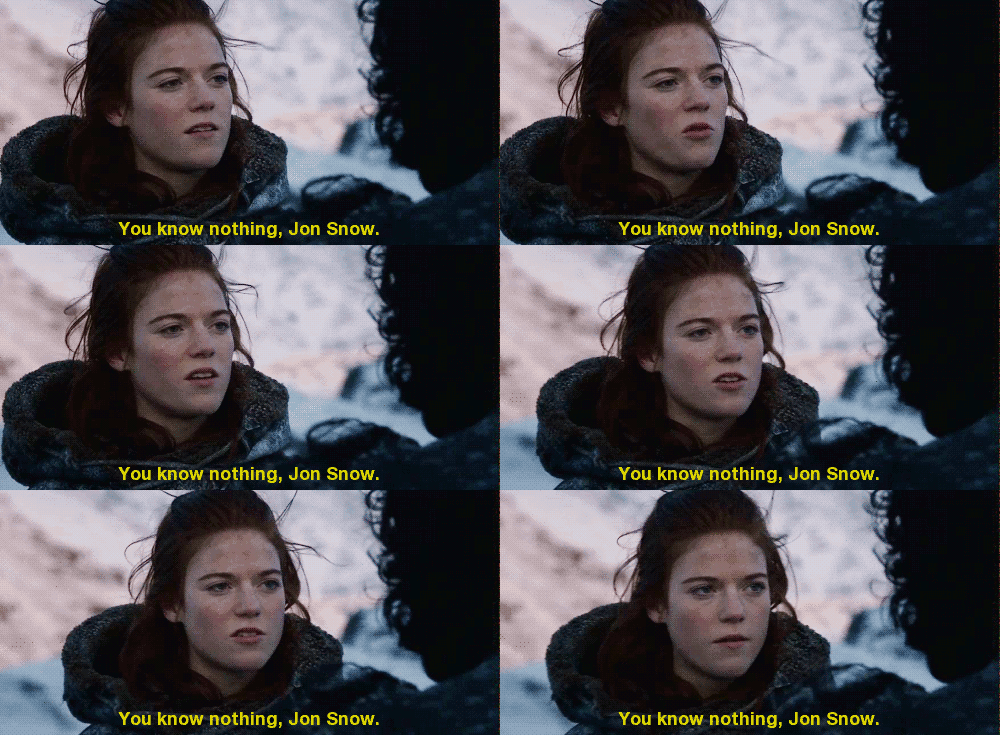 |
| Ygritte gets it |
