A humanities scholar's occasional ramblings on literature, science, popular culture, and the academy.

Monday, September 16, 2013

Why are there no _______?

Alice Walker once said, “The most common way people give up their power is by thinking they don't have any.” As a corollary to this, you could say that the easiest way to take away people’s power is by pretending that they have none. I call this the The Last of the Mohicans problem. For the better part of the past two centuries, it’s been fairly common to see popular culture depict Native Americans in a way that emphasized how much of the population had been lost and how much of the culture had disappeared. James Fennimore Cooper’s novel exemplifies this mentality right in its title. For European Americans, the notion serves two purposes: it provides a language with which to process guilt over the various historical injustices that have been done to Native Americans, and it situates those injustices firmly in the past, rendering contemporary Native Americans invisible. The The Last of the Mohicans problem is a way of affecting a multicultural ethos without ever having to confront the realities of the less privileged groups with which you coexist.

Lately, I’ve been noticing instances of a close cousin to the The Last of the Mohicans problem--the Why are there no _______? problem. Like LotM, Watn_? is typically expressed by well-intentioned, progressively inclined folks, and like LotM, Watn_? renders invisible the real people for whom the assertion purports to advocate. But unlike LotM, Watn_? doesn’t assume that those people are extinct, only underrepresented.* The great irony of Watn_? is that those problems of underrepresentation are typically very real, but Watn_? not only fails to address those problems, it actually contributes to them.

Buggin' Out got so angry, he moved to Albuquerque and built a drug empire.

Three examples of Watn_? have been on my mind lately. Two of them are recent, and one is from a few years ago, but still relevant.

1. Why are there no black people in science fiction? 

Or, as David Barnett put it in The Guardian, “Why are most SF authors straight, white western men?” Josh Finney quite persuasively rebuts this criticism by, among other things, pointing to the way in which assumptions of whiteness undermine the work being done by creators of color. Discussing how Klingons and Ferengi are perceived as racial stereotypes, Finney writes:
[L]et me tell you, Jimmy Diggs was personally responsible for some of that aggressive Klingon behavior. And to hear him tell it, he was highly influential in some of the best remembered Ferengi episodes. You know what else? Jimmy is black. And fuck, if Jimmy can to be slammed for these portrayals, what chance do I have?
It’s certainly possible to still argue that the Klingons and Ferengi are racial stereotypes (let’s be real here: they totally are). But an awareness of Jimmy Diggs’s race and his contribution makes it harder to see Star Trek’s handling of race as simply stereotyping. Greater awareness of the existence of creators of color leads (or at least ought to lead) to a more sophisticated understanding of the works. That awareness isn’t there right now, and Finney places responsibility for that fact not on the science fiction community, but on consumers, especially white liberal consumers like David Barnett:
It’s not their cry for diversity that’s the problem. I agree. More diversity would be great. But throwing stones at aging white guys isn’t going to fix anything (especially when they’re quantifiably less racist than the average American). Nor is lobbying publishers a solution. The best that’ll result in is a slew of bland, safe, token characters gratuitously crammed into stories for the sole purpose of shutting people up. 
You want sci-fi stories with more color, women, gays, transgendered, and “non-white” settings? Easy. START BUYING THEM.
2. Why are there no Christian LGBT allies?

Dan Savage has a term for pro-gay rights Christians, NALTs, which stands for Not All Like That. Savage came up with the term to refer to Christians who would come up to him and “whisper” that they are not all like that--”that” being Pat-Robertson-style hate mongerers. Savage has frequently expressed resentment that these NALTs do not do more to publicly denounce anti-gay Christian conservatives, and recently several pro-gay rights Christians have taken up the NALT label and transformed it into an “It Gets Better”-style project, with Savage’s support.

I’m a fan of Savage, but NALT always rubbed me the wrong way, for reasons this blog post nicely articulates:
I get where Savage is coming from, but the idea that the people Savage called NALTs were somehow only privately so, in a “just-between-me-and-Dan-Savage” kind of way, always seemed a frustrating sleight of hand that belied the relative power imbalance between traditional and non-traditional Christian communities. I’m just not sure if I can in good conscience support popularizing a term that I think is dismissive of non-traditionalist Christianities.
Going a step further, not only does Savage’s use of NALT undervalue the efforts of pro-LGBT Christians, it also rhetorically treats “Christian” and “queer” as if they are mutually exclusive terms. I’m neither Christian nor LGBT, but I know people that are both and I know that it is possible to be both at the same time. I don’t think it helps anyone to pretend like you can’t be.

3. Why are there no women on The Daily Show?

This one’s old, but it came up again recently in a discussion I was having about Jessica Williams, the newest (though not so new anymore) reporter on the Comedy Central series. Williams replaced Olivia Munn, whose short time at The Daily Show was noteworthy mostly because it provided an occasion for Irin Carmen to call the show a boy's club. Now, I don’t know why Munn left, and I think Jessica Williams is hilarious, but to this day, Carmen's article bothers me for a couple of reasons.

First, it insinuated that Munn was unqualified for the job, suggesting that she had been hired because she is conventionally attractive, despite the fact that she had been the cohost of a comedic talk show (Attack of the Show) for four years. Second, the article alludes to the systemic issues having to do with the exclusion of women in comedy, but maintains a narrow focus on the question as to whether or not Jon Stewart/The Daily Show is sexist. Madeleine Smithberg points to the bigger picture, but rather than analyze the implications of the show's place in a larger industry, the article turns the focus on Munn. Third, it reduced the creative conflicts between Smithberg and Stewart to Stewart throwing a newspaper, an irrelevant detail that equates being a jerk with being a misogynist and that, implicitly, suggests that women can’t handle the adversarial environment that characterizes the late night talk show. All of these details suggest an analytical approach that is more invested in affirming the existence of inequality than it is in challenging inequality in any meaningful way.

I’m not saying that underrepresentation isn't a real problem or that questioning underrepresentation has no value. Sometimes, versions of the Why are there no _______? question can lead to interesting counterfactual thinking. When Dustin Rowles asks “Where’s the female Walter White?” for example, the question touches on the intersections of gender, genre, and audience expectations in interesting and generative ways (even if Rowles’s focus on parenting seems like a partial answer at best). But asking the question doesn’t automatically challenge the injustice that it points to. In fact, it might do the opposite.

*Okay, I suppose I could call it the Why are there so few _______? problem, but Why are there no _______? better captures the question's tendency towards hyperbole.

Thursday, August 29, 2013

How the Humanities Gave Me Thick Skin and Taught Me Humility

Reflections on being unfriended by a Facebook acquaintance

A few days ago I posted to Facebook Anna Gunn’s essay about her experience being hated and even receiving death threats for her portrayal of Skyler White on Breaking Bad. The post prompted an excellent debate about Skyler White with a couple of acquaintances, one of whom was a former grad school colleague and one of whom was someone I vaguely knew in high school. It was the kind of debate you occasionally get in grad school seminars or in Facebook comment threads, especially between academics—passionate yet dispassionate, heated but not personal, a genuine debate over how to interpret the character that managed not to descend into a flame war. At least not in my opinion.

This fall I’m teaching a writing course titled “Arguing about Interpretations,” the entire goal of which is to replicate these sorts of debates in essay form. I wanted to use this comment thread in my class as an example, so I went to ask my two acquaintances permission, only to discover that my high school acquaintance, who is not an academic, had unfriended me. In our discussion, this individual had made some valid points but his comments contained problematic implications regarding the role of women on popular TV shows, and I pushed back against those implications. I can’t know for certain, but I have to assume that that pushback is what got me unfriended.

Out of respect for his wishes to unfriend me, I haven’t contacted him, and I won’t share further details of my exchange, except to say that I followed Jay Smooth’s classic advice on how to tell people they sound racist (applied to sexism), keeping the focus on the words (as well as on Breaking Bad as a text and the cultural context surrounding the show) while avoiding any claims about him as a person. I’m used to vigorous debates of this sort, so it was easy for me to see it as impersonal, but seeing that this acquaintance had unfriended me caused a moment of reflection on how I might’ve come off as an jerk.

Thing is, I don’t feel bad about coming off as an jerk, and not because I’m a raging lefty feminist academic who believes that unconsciously sexist attitudes must be challenged at every turn, but rather because I sincerely believe that anyone ought to be able to take criticisms lodged against their interpretations, their assumptions, their ideology or worldview as long as those criticisms are not vulgar or packaged with ad hominem attacks.

I take Avenue Q’s message to heart: Everyone’s a little bit racist. And sexist. And classist, homophobic, transphobic, fatphobic, ableist, xenophobic, etc. It’s impossible to live in a society where structures of privilege exist without internalizing these attitudes somehow. Acknowledging this reality means that when someone calls you out on the problematic implications of something that you’ve said or written, it doesn’t have to be crippling. It doesn’t have to produce feelings of guilt and subsequent feelings of defensiveness.

This is something that I might never have learned had I not gone to grad school. I come from a position of tremendous privilege, and consequently over the years I’ve given other people plenty of opportunities to point out the limitations of my perspective. Hell, even in my dissertation defense, the most pointed criticism had to do with my handling of race (in a series of texts where handling race well is really damn important). With these criticisms I’ve learned to listen, reflect, and further engage. I don’t always agree with those criticisms—“check your privilege” is not a trump card—but I take them seriously and they don’t derail the conversation for me.

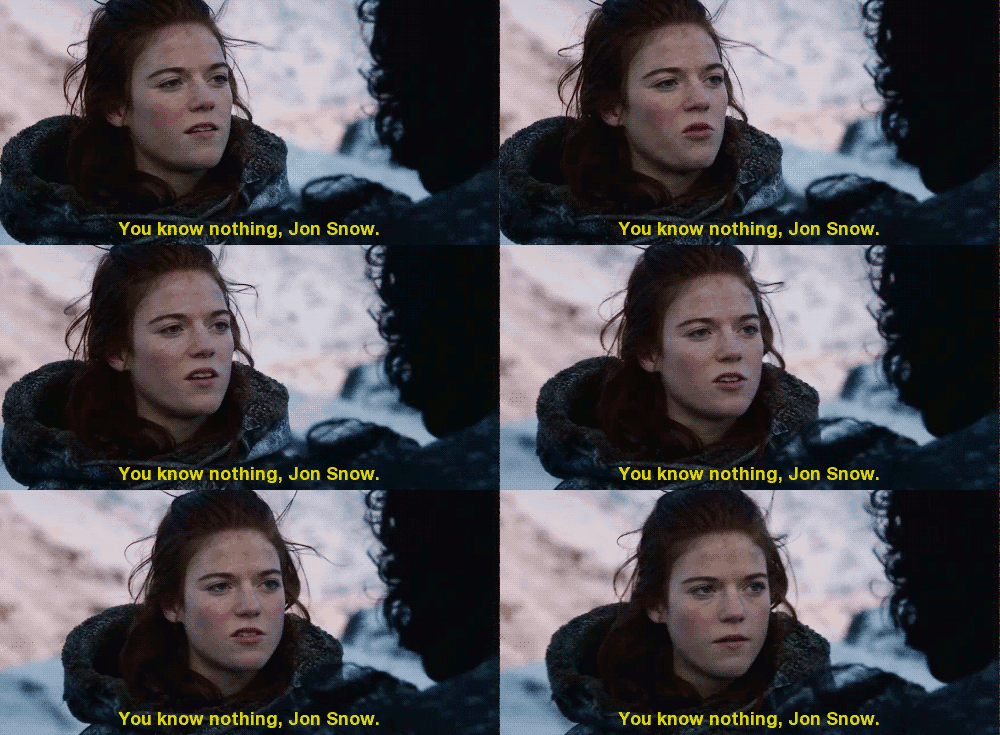
A humanities education taught me how having thick skin and having humility can go hand-in-hand, but this shouldn’t be exclusive to grad students and professors. Instilling this attitude towards receiving criticism is one of my primary goals as a teacher, because I genuinely believe that it’s something every college student can and should learn. It’s also one of the most valuable skills a humanities education can instill that a science education can’t (or at least, they can’t do it as well). My biologist girlfriend reserves the last day of her class to give a lesson on why evolution isn’t an excuse to be an asshole. Basically, it’s a one-day refutation of Social Darwinism. It’s good that she does that, but that can’t exactly be the focus of a biology class. They have to spend most of their time just learning biology. Generally speaking, a scientific education can feel tremendously empowering, in the sense that Francis Bacon conveys when he says, Knowledge is power. A humanities education can feel tremendously disempowering, in the sense that Socrates conveys when he says, “I know that I know nothing.”

But more importantly, a humanities education can make you feel comfortable acknowledging how little you know, because that is the beginning of inquisitiveness. If more non-academics took that attitude, it would be easier to have a lively Facebook debate.

Ygritte gets it

Monday, June 24, 2013

The Social Construction of Clarity

Verlyn Klinkenborg wrote an essay in The New York Times on “The Decline and Fall of the English Major.” There are many things that could be said about this essay, but I’ll be brief. I came to the essay by way of a blog post from Erik Voeten on The Monkey Cage, and it is Voeten, not Kilnkenborg, to whom I’d like to respond. Voeten quotes a simile that Kinkenborg uses:
Studying the humanities should be like standing among colleagues and students on the open deck of a ship moving along the endless coastline of human experience. Instead, now it feels as though people have retreated to tiny cabins in the bowels of the ship, from which they peep out on a small fragment of what may be a coastline or a fog bank or the back of a spouting whale.
Voeten responds:
Sentences like this usually lead me to liberally spread red ink. What do you mean? Why should studying be like observing a coastline rather than interacting with human experience? Why the clichés? And what’s that whale all about?  You can sort of figure out what the author means with all the vague metaphors but “sort of being able to figure out” an argument is hardly an advertisement for clear and simple nonfiction writing.
I will note in passing the irony of Voeten making this argument on a blog that takes its title from an H.L. Mencken quotation featuring a metaphor that, in my opinion, is far more vague and “flowery” than Kinkenborg’s simile. I would also be remiss not to observe that Voeten manages to be deeply invested in clear writing instruction while seeming not to know or care about the difference between a metaphor and a simile.

What’s interesting to me is, Klingenborg’s simile has a much clearer point to it than Voeten’s criticism does. A good simile or metaphor—and I would say that Klingeborg’s simile is pretty good—can take an abstract idea and make it more concrete through analogy. The boat simile illustrates Klingenborg’s point that disciplinary specialization in the English major has led English departments to feel like a hermetic environment that is cut off from the reality that it purports to study, leading to warped perspectives. The simile might be somewhat imprecise, but I wouldn’t call it vague, and indeed, a greater degree of precision might not be appropriate for an essay commenting at this level of generality.


Voeten’s response, meanwhile, is a set of directionless and open-ended questions that would, ironically, lead me to “liberally spread red ink” (or they would if I actually graded in red ink—I find that students are more likely to read comments if they are in blue). The rhetorical questions reveal more about Voeten’s reading protocols than they do about anything inherently “vague” or “muddled” in Klingenborg’s writing.


I like similes/metaphors and I detest rhetorical questions. Voeten appears to like rhetorical questions and to detest similes/metaphors. Both of us would likely justify these matters of taste in terms of “clarity,” and a preference for “clear” writing. But really, these preferences are matters of taste, and both Voeten and I have acquired our tastes through years of reading and writing and interacting with other readers and writers.


It’s easy to forget that “clarity” is a social construct that differs across institutions, disciplines, and parts of the world. Contra Klingenborg, I don’t actually think that the humanities have become too technically narrow. If anything, they’ve become too broad, with growing interests in world literatures, cultural studies, and interdisciplinarity making it nearly impossible to develop a consensus with regard to what constitutes a “good” or “clear” writing style.


At the end of the day, I think that this broadening is a good thing, but it might mean giving up on any totalizing ideas about “teaching how to write well.” Instead, I think that writing instructors should focus on providing students with a set of rhetorical techniques that they might or might not want to employ in given circumstances (in my writing classes, I use a “toolbox” metaphor: over the course of the semester, we fill their toolbox with tools that they might or might not use later, but that they should always have at their disposal). And, given the plethora of “good” writing styles out there, I think that the humanities as a whole should be less focused on producing good writers and more focused on producing good readers who can consume different kinds of texts and understand them clearly.


Thursday, May 30, 2013

You Keep Using That Word...

So Lou Dobbs, Juan Williams, Doug Schoen, and Erick Erickson all recently freaked out on Dobbs’s Fox News program over the trend of more women becoming the primary breadwinner in their homes. I sense that so much has already been said about this clip, I don’t have a lot to add, so I’ll keep this one brief.

I want specifically to address Erickson’s quote:

I am so used to liberals telling conservatives that they are anti-science. But I mean this is -- liberals who defend this and say it's not a bad thing are very anti-science. When you look at biology, look at the natural world, the roles of a male and female in society; in other animals the male typically is the dominant role.

He doubled down on this assertion on his blog:

Pro-science liberals seem to think basic nature and biology do not apply to Homo sapiens.

This is a favorite rhetorical trope among conservatives—taking the accusations that liberals often lodge at them and turning them around. No, you’re the sexists! No, you’re the racists! No you’re anti-science! It might be sophomoric, but it makes sense that conservatives would look for opportunities to put liberals on the defensive in this way. And many liberals do have a bad habit of throwing around rather inflammatory allegations of racism and sexism in often glib and unsophisticated ways.

But often, these attempts to turn the tables belie a fundamental misunderstanding of the terms. Now, I’m not going to address what science actually has to teach us about gender roles (boy, I do NOT have that kind of time) or specific scientific findings about males and females (except to say, “in other animals the male typically is the dominant role” -- whoa nelly does that seem like an oversimplification). Instead I want to address a more basic assumption that Erickson is making about what science is and what role it plays in public policy.

Science is descriptive, not prescriptive. It tells us how things are, not how they ought to be. Certainly, many scientists will comment on how things ought to be, and as citizens, it’s their right to do so, but in those contexts, they’re speaking as citizens; they’re not speaking for science. “Should” isn’t really a part of science’s vocabulary. Science tells us that climate change will cause sea levels to rise and myriad other ecological changes. Science doesn’t tell us that we should do anything about this—our values tell us that. When we pro-science folks accuse a segment of political discourse of being anti-science, what we mean is that we want policy discussions to begin with a common base of knowledge that is built on sound scientific research. We’re not saying we should do what science tells us to do, because science isn’t telling us to do anything.

Using science in the way that Erickson uses it—trying to derive an “ought” from an “is”—is one version of a logical fallacy called an appeal to nature. You can make an appeal to nature without citing “science” explicitly, though science tends to float in the background whenever anyone talks about nature, and appeals to nature are all over our political discourse, not just on the right. Mainstream public discourse on gay rights is particularly interesting in this regard, because both sides of the debate have largely accepted the premise that an appeal to nature is appropriate, with homophobes decrying homosexuality as “unnatural” while gay rights activists assert that they were “born this way,” as if being born that way were relevant (I often wish that Lady Gaga had written a song titled “My Sexual Freedom is Not Contingent on How I Was Born,” but I guess it’d be harder to put that to a dance beat).

Appeals to nature in political discourse go all the way back to the beginnings of modern democracy and Enlightenment philosophers’ construction of “natural rights.” But just because something is natural doesn’t mean that it’s better. There is nothing natural about indoor plumbing, but I imagine that Erick Erickson still uses a toilet. Even if science taught us that every other animal species on earth had dominant males and subservient females, that would say nothing about what gender roles should be for humans.

So, Erick Erickson, if you’ve been accused of being anti-science, it’s not just because you don’t make informed decisions about matters where scientific findings are relevant. It’s because it seems like you don’t understand what science is.

Wednesday, May 15, 2013

"Fitch the Homeless"

Does pointing out problematic aspects of "feel-good" texts have to make you a kill-joy? Does liking these problematic texts make you a bad person?


When I saw the “Fitch the Homeless” video, I laughed. When I read criticisms of the video, I (mostly) agreed with those criticisms. I do not think that these two things are mutually exclusive.

Texts are ambiguous. Novels, essays, speeches, movies, jokes, YouTube videos—any kind of text will inherently convey multiple messages, sometimes self-contradictory messages. There might be a wrong way to interpret a text, but there is rarely (if ever) only one right way to interpret a text. If this ambiguity weren’t an inherent facet of communication, there would be no need for English professors.

Stacy Bias mentions the “displaced rage I get flung at me when I point out the damaging parts of ‘feel-good’ social phenomenon.” This sounds very familiar. It calls to mind some of the discussions I saw around the Dove Real Beauty Sketches ad that came out a few months ago. It also calls to mind conversations I’ve had about the Human Rights Campaign and its problematic place in the gay rights movement. And the memeification of Charles Ramsey. And Kony 2012. And the place of “green” consumerism within the environmentalist movement. And so on and so on.

It’s a common reaction to feel defensive when confronted with the problematic aspects of a text that you enjoyed or found value in. The critique of the text can easily feel like a critique of you for liking that text. Am I guilty of cultural appropriation because I reposted a Harlem Shake video? Am I anti-feminist because I saw some satirical value in Seth MacFarlane’s Oscar jokes? Am I an imperialist because I thought Zero Dark Thirty was an anti-torture movie? As a way of avoiding self-recrimination, we often feel the need to defend the original text in ways that can escalate quickly. That’s how someone with good intentions can paint themselves into a corner and end up sounding like a jerk. While I don’t think I’ve ever felt “rage” when confronted with the damaging parts of these feel-good texts, I have been on both sides of these defensive feelings more than once.

I think guilt of this sort is counter-productive. Bias titles her post “Feminist Killjoy,” but pointing these things out only kills joy if you allow yourself to focus on self-recrimination rather than on the opportunity to create a (humanities instructor cliché alert) teachable moment. I recoil at absolutist language—words like “nothing” or “completely”—because they tend to shut down those teachable moments. Using those sorts of absolutist terms might be appropriate when talking about material matters, but they are rarely helpful when analyzing texts. This is one of the first lessons that I teach my writing students.

That use of absolutist language is the only criticism I have of Stacy Bias’s post, which is representative of a tendency that I see in a lot of similarly “killjoy” criticism (again, I have done this as well). For example, Bias writes, “the very crux of this joke on Abercrombie & Fitch is that their clothing will now be associated with the stigma of homelessness. This project does nothing to eradicate that stigma.” That wasn’t how I initially viewed the video. I saw it in contrast to these guys. The purpose behind “HoboJacket” is to create an association between the rival school and people who you consider "lesser." The message behind the donation inherently reinforces the stigma. With "Fitch the Homeless," the purpose behind the donation is to assert that it's wrong to cultivate a brand identity that's based on excluding people who you consider "lesser." It's certainly possible that that message reinforces the stigma in the same way, but that's not the only way to interpret it in this case.

Again, texts are ambiguous, and if you draw out a message that is of genuine positive value from a text, that can be just as legitimate as an interpretation that draws out a negative message. That, to me, is the definition of “problematic.” By starting with an acknowledgement of the ambiguity, nobody has to sacrifice the positive aspects when they acknowledge the negative. In that way, a conversation about what a text is transforms into a more nuanced conversation about language, structure, speakers, audiences, and contexts. Determining the point of emphasis--positive or negative--can be tough: there are few bad texts out there without some redeeming qualities, and few good texts without some problems. The ultimate test is what people do with the insights that the texts provide--what material impact they have on the world. Those impacts are uncertain, difficult to measure, and often indirect, but determining whether those material actions are damaging or helpful strikes me as far less ambiguous.

Monday, April 29, 2013

Should you go to graduate school in the humanities?


Should you go to graduate school in the humanities?

No, because you will find yourself surrounded by neurotics who wring their hands and solipsistically lament “the state of the field.”

Yes, because you will find yourself surrounded by thoughtful individuals who engage in continuous critical self-examination about their work and its place in society.
________________________________

For about the past month, my Facebook feed has been filled with discussions on this question, should you go to graduate school in the humanities? This question typically accompanies links to articles exploring the question. It started with this piece in Slate, and  has continued more recently with this piece in The New Yorker, with several others in between.

It’s good that these articles are being written. Going to graduate school represents a substantial investment of time and energy on a kind of professional development that, given the precarious nature of the academic job market, entails tremendous risk. That being said, I haven’t read these articles. When one of my Facebook friends posts them, I never click on the link, and I often hide the post from my Facebook feed. These articles aren’t for me—they’re for those who haven’t yet made a decision that I made many years ago. I know that, at best, these articles will provide me with an opportunity to pat myself on the back and say, yes, going to graduate school was the right choice. A far more likely possibility is that these articles will leave me with a feeling of regret about a choice that I can’t undo. I’m prone to anxiety as it is—I don’t need Slate or The New Yorker to help me on that front.

Which is why I’ve been surprised that so many of my friends have continued to post these articles and engage in lengthy discussions of them, since most of these friends are are, like me, on the tail end of their Ph.D. and thus not the articles’ target audience. After some discussion with a few of them, it became apparent that this wasn’t about wallowing in their depression, as I often suspected. Nor was it about figuring out what to advise someone were they to ask if they should go to grad school (like the articles’ titles suggest). It wasn’t even about how our field is perceived by the middlebrow intellectual audience that Slate and The New Yorker represent.

Instead, these articles are serving as a vector through which people can communicate their existing feelings of anxiety about the future. There’s an element of self-flagellation to this that I don’t appreciate. By broadcasting their regrets about their decision to go to graduate school, many graduate students not only insult themselves; they also insult others who are in the same precarious situation. But the fact that these discussions appear to be so damn common among later-year Ph.D. students indicates that they are filling a real need—a need that our graduate programs are not filling.

There are two personality traits of people who get into graduate school: ambition and inquisitiveness. These two are not mutually exclusive; in fact, if you want to be successful you had better be both. But graduate programs—top-tier graduate programs in particular—are not equally skilled at cultivating both sides of their students personalities. As the job market has become more competitive, the culture of graduate school has, in many tangible and intangible ways, done more to cultivate ambition, such that, by the time you complete your Ph.D., acquiring a tenure-track job has been imbued with a symbolic importance that far exceeds its practical importance

But practically speaking, those jobs simply won’t be there for many of us. Taking a broad view, I’m frustrated with the academy for not doing more to adapt to the technological and economic changes that led to this situation. Had the field adapted, it might’ve better demonstrated its worth and there would be more jobs out there. But more immediately, I’m frustrated with the academy for perpetuating an outdated sort of tenure-track fetishism that places blinders on its students at a time when they most need a full range of vision.

The reason many later-year Ph.D. students are posting “should you go to graduate school?” articles is because there aren’t many “should Ph.D.s get professorships?” articles out there. But that’s the question we are—and should be—asking. Many of us lack the professional guidance necessary to navigate this job market as it exists in 2013. How might it be possible to subsist as an adjunct professor or a lecturer? Where does one find international job opportunities? What about high schools or community colleges? What about administrative positions or libraries? What private industry jobs might value a humanities degree, and how do we market ourselves towards those jobs? Is it possible to teach at a university on a part-time basis while doing other things? How do we address the two-body problem?

A focus on narrowly defined professional ambitions—the tenure-track professorship—makes just asking these questions an exercise fraught with anxiety. But graduate programs have a responsibility to answer these questions, and to do so early in their students’ graduate careers. If graduate programs did that, it might be possible for their Ph.D.s to see that there are many ways to succeed as members of an academically-literate intellectual community regardless of whether or not they are "academics" in the most conservative sense of the word. This is necessary on a practical level to ensure students' financial well-being, but it’s also necessary to ensure their emotional well-being. And I think that they would be easier questions to answer if graduate programs cultivated inquisitiveness the way that they cultivate ambition. If graduate programs don't start doing this, then we’ll all just keep freaking out on Facebook.

ADDENDUM: If graduate schools do want to narrow their students' options to the tenure-track professorship, they're free to do so, but they had better accept far fewer students into their programs. If they still want to exploit graduate student labor, they had better provide those students with more professional options.

Thursday, April 11, 2013

Etiquette Guidelines for Students Interacting with Instructors


I've been thinking a lot lately about the reasons why instructors (graduate students in particular) get frustrated with their students. Often these frustrations stem from a sense of entitlement that instructors get from their students--a sense of entitlement that stems from unreasonable demands on the instructor's time or a simple lack of common sense. But I've been wondering if we're being unfair. A lot of those frustrations are our own fault for not making our expectations clear from the outset, and what we gloss as "entitlement" might in fact be simple ignorance. It requires a lot of socialization to succeed in a university environment and an explicit primer on the social norms that govern that environment might be one of the most empowering tools that we can give our students. With that in mind, I've made the following handout, which I think could be a very effective teaching tool, especially for first year students in the context of a small class, like a first-year writing course.


Etiquette Guidelines for Students Interacting with Instructors

Success in any college course is determined by your performance on the graded material—the exams, the papers, the other assignments—but it is also determined by the relationship that you cultivate with your instructor. This might not seem intuitive, but making a good impression on your instructor and cultivating a positive relationship with them can lead to many tangible benefits. It can mean that the instructor will be more likely to excuse an absence or provide you with an extension on an assignment. It can make them more inclined to bump up a borderline final grade. It can turn them into a source for a letter of recommendation. And it can determine how harsh or lenient they are when they evaluate the more subjective components of your grade, like essays or participation. Cultivating a positive relationship with an instructor requires following certain etiquette rules. Some of these may seem obvious, but they are all important:

DISCUSSING COURSE POLICIES

DO read the syllabus closely and consult it for answers to questions about course policies.
DON’T ask your instructor questions about the course that are answered on the syllabus.

DO ask for clarification about course policies or assignments as soon as possible.
DON’T wait until right before the due date to ask questions about the assignment.

EMAIL

DO begin emails with a salutation and end with a signoff.
DON’T misspell your instructor’s name.

DO give your instructors 24 hours to respond to email, not including weekends.
DON’T expect an immediate response to a message, especially one sent late at night.

DO be the last person to send an email during an email exchange. When arranging a meeting, it is your responsibility to send the last email confirming the meeting time. If you do not send the last email, your instructor might assume that the meeting isn’t on.

OFFICE HOURS

DON'T ask questions via email that will require a long response and DON’T ask for feedback on written work via email.
DO use email for short, direct questions. DO use office hours for any questions that require extensive feedback or a back-and-forth conversation.

DO take notes during office hours. You likely won’t remember all of the instructor’s advice.

If an instructor offers a block of time when they are available other than their regular office hours, DON’T assume that they will be in their office during that time. They are offering a block of time when they could be in their office if you make arrangements to meet with them.

DON’T refer to a meeting outside of the regularly scheduled office hours as “office hours.”

DON’T miss a meeting outside of regularly scheduled office hours, except in an emergency.
DO email to explain why you missed an appointment as soon as possible.

ABSENCES

DO email your instructor ahead of time when you know you'll miss class for an excused absence.
DON'T assume that by emailing ahead of time, your absence is automatically excused. Ask.
DON’T email your instructor about an absence that you know isn’t excused.

DO ask a classmate what you missed in class when you were absent.
DON'T ask your instructor what you missed—not in email or in office hours.
DEFINITELY DON’T ask, “did I miss anything in class last week?” The answer is always yes.

DON’T assume that an assignment can be turned in late because you were absent.
DO turn in your assignment even if you are absent, or arrange for an extension.

PROFESSIONALISM

DO maintain a professional tone with your instructor.
DON’T share details from your personal life, unless they are affecting your performance in class.
DON’T try to friend your instructor on Facebook (maybe after the class is over, if you had a positive relationship).

DON’T text or check Facebook. Your instructor can tell.

If you are late, DON’T interrupt a lecture or a student’s presentation by walking in.
DO wait by the door until there is a moment when walking in won’t be distracting.

If you must leave early, DO tell the instructor beforehand, sit near the door, and slip out quietly.
DON’T walk out of class in the middle of a lesson without warning.

DON’T lie to your instructor. You’d be surprised how easy it is to get caught. Don’t say you’re only available during a two hour window, only to arrange a meeting for a different hour of the day. Don’t tell an instructor you uploaded an assignment to the course website when you haven’t. Don’t kill the same grandmother twice when explaining your absences.
_________________________________

Generally speaking, these DOs and DON’Ts are all about empathizing with your instructors and understanding what they value in a relationship with a student. Many students assume that their instructors value “respect” in some abstract sense of the term. This isn’t exactly true. For example, many people who hold Ph.D.’s don’t particularly care if you call them “Doctor” or “Professor”; in fact, many will ask that you call them by their first name. 

The top three things that most instructors value are:
  1. Their time. Think about who is teaching your course. If it’s a full professor, they’re probably in the process of writing a book or an article, or they’re engaged in some research project. If it’s a graduate student, they’re probably taking courses or writing their dissertation, and might be applying for jobs. If it’s a lecturer or adjunct professor, they’re probably teaching many courses at once and applying for jobs. In any case, teaching you is not their only responsibility. This doesn’t mean they don’t enjoy teaching you or that they don’t work hard at it, it’s just the nature of the university. So if you’re going to respect anything, respect your teacher’s time, and don’t waste it.
  2. Their students’ time. If an individual student isn’t paying attention during a lesson, many instructors won’t be offended, but if a student distracts other students during a lesson, they’re very likely to incur their instructor’s wrath.
  3. Their work. Instructors love the thing that they’re teaching about, and they work really hard at it. So, the easiest way to make a bad impression is to give your instructor a sense that you are bored or lazy. If they sense that you don’t care about the material, then they won’t care about you. On the other hand, the easiest way to make a good impression is to show some passion for the material, or at least some genuine interest. Even if it’s a required course that you aren’t particularly excited about, finding a way to show enthusiasm will go a long way.